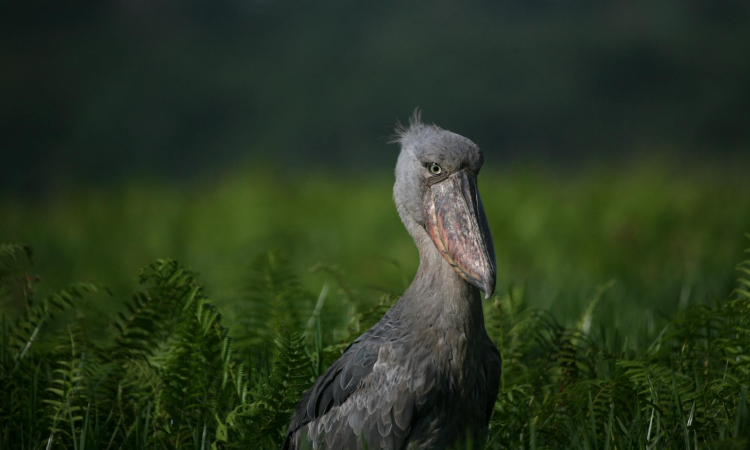
Satisfy your love for adventure by tracking the rare shoebill bird in Semuliki National Park. This bird’s history goes back to the dinosaur era. For many years, it was wrongly classified as a stork, but it has now been reclassified as a pelican because its eggs and DNA are similar to those of pelicans. The male shoebill weighs about 12 pounds, making it heavier than the female. Its body and wings are shaped like those of a condor, although they are not related.
Shoebills are easy to recognize by their massive shoe-shaped bills. They have grey feathers, which are brown when they are young, a short neck, and wide wings built for soaring. Their strong bills help them catch and kill prey such as fish, rodents, turtles, and sometimes small birds when food is needed.
Shoebill tracking in Semuliki is a guided activity led by experienced birding guides. They follow bird calls and sounds to help visitors locate different species. Along the trails, you may also encounter more than 140 other bird species. The best trails for shoebill tracking include Kirumia Trail, Wasa River Trail, and Sempaya Nature Trail.
To enjoy this activity, book early and carry your own birding equipment such as binoculars, cameras, and extra batteries. Keep in mind that shoebills are sensitive to noise, so your gear should be quiet to avoid scaring them away.
The best time to track shoebills is during the wet season from March to mid-May and September to November, which is the breeding season for most birds. This period offers the chance to see many different birds, including migratory species that visit between November and April.
The dry season is also good for birders, as the trails are easier to pass and visibility is clearer, making photography more comfortable even though bird numbers may be lower.
Discover the shoebill and other bird species during your visit to Semuliki National Park.